Maintaining a garden throughout the year means juggling very different tasks depending on the season: preparing the soil in spring, watering in summer when restrictions are in place, collecting leaves in autumn, and protecting plants in winter. The equipment you choose affects how easy each task is, as well as how long your investment will last. Several regulatory and technical developments are also changing the way people choose gardening tools today.
Noise regulations and power tools: rules governing their use in the garden
Before choosing a power tool, it is worth considering noise levels. Mowing and hedge-trimming hours are governed by local or regional regulations, with time slots generally more restricted on Sundays and public holidays.
A gardener using a powerful petrol lawn mower on a Sunday morning may therefore face real penalties. These rules are prompting more and more homeowners to choose battery-powered tools, which are significantly quieter than their petrol-powered equivalents. The reduction in decibels often makes it easier to comply with permitted hours without sacrificing cutting power for a medium-sized lawn.
The range of products available from Perspectives Jardin’s equipment section illustrates the variety of solutions on offer, from lawn mowers and hedge trimmers to leaf blowers, to suit these requirements.
Replaceable batteries and durability: an overlooked factor when buying garden tools
Most competitors list tools without discussing their life cycle. Yet this is a subject that deserves particular attention when it comes to battery-powered equipment, which accounts for a growing share of the market.
The European Batteries Regulation (EU) 2023/1542 introduces requirements for the removability and replaceability of portable batteries from 18 February 2027. In practice, this means manufacturers will have to design appliances with batteries that can be removed and replaced by the user or an independent professional.
When buying a tool today, it is still worth checking three things before making your choice:
- Is the battery already removable and sold separately, or does the entire appliance have to be sent back to the manufacturer if it fails?
- Does the manufacturer offer replacement parts for the motor and battery pack for at least five years?
- Is the battery format shared across several tools from the same brand, reducing the number of chargers needed and avoiding duplicate purchases?
The exact application of the regulation depends on the type of equipment, and some exceptions remain. Checking battery compatibility and availability is therefore a more reliable habit than waiting for the legislation to come into force.
Garden watering and water restrictions: choose equipment to suit local conditions
Watering is the area that varies most from one year to the next. Buying a timer or a drip irrigation system does not guarantee that watering will be permitted during a drought. Restrictions vary according to the alert level (watch, alert, heightened alert, emergency) and the municipality.
For example, the Nord prefecture sets out different rules for lawns and vegetable gardens depending on the alert level in force. On the Vigieau website, anyone can check which restrictions apply at their address. A vegetable garden may sometimes be watered even when a lawn can no longer be, which changes the order in which equipment should be prioritized.
For a garden that works well year-round, the most resilient combination is a drip irrigation system (low water use, targeted at the roots) and a rainwater collector. A rainwater collector is not just a passive accessory: Bati-Avenue’s guide highlights the importance of filtering out leaves and debris, providing an overflow outlet, and winterizing above-ground tanks. Regularly checking and cleaning the filters in autumn helps maintain the quality of stored water and extend the tank’s lifespan.
Checking with your local authority before buying a model from a garden center may help you qualify for local grants for rainwater collectors.
Soil care and pruning: choose tools to suit the ground
Hand tools for working the soil are still the foundation of any garden, but their suitability depends on the type of soil. A broadfork is suitable for soil that is already loose, while a traditional spade is essential for compacted clay. A digging fork is mainly used to aerate the soil without turning over its layers, an approach that aligns with gardening practices aimed at preserving microbial life.
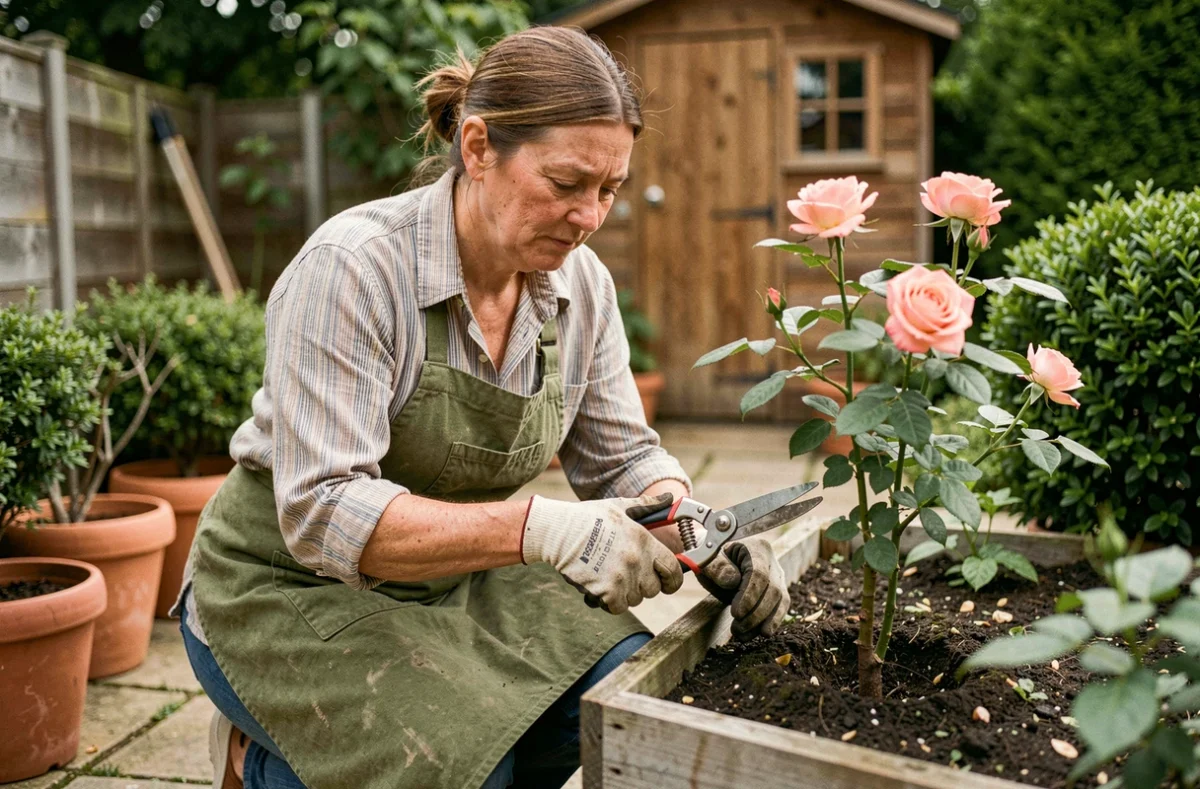
When it comes to pruning, the choice between an anvil pruner and a bypass pruner is not insignificant. The former slightly crushes the branch (making it suitable for dead wood), while the latter makes a clean cut (better for green wood). A ratchet lopper completes the toolkit for thicker branches, without the need for a chainsaw.
Looking after these tools is key to extending their lifespan:
- Sharpen the blades of pruners and shears at least twice per season, and more often during periods of intensive pruning
- Disinfect the blades with alcohol between shrubs to limit the spread of fungal diseases
- Oil the springs and joints before storing tools for winter, then keep them in a dry place
Protective gear and storage: the often-overlooked essentials
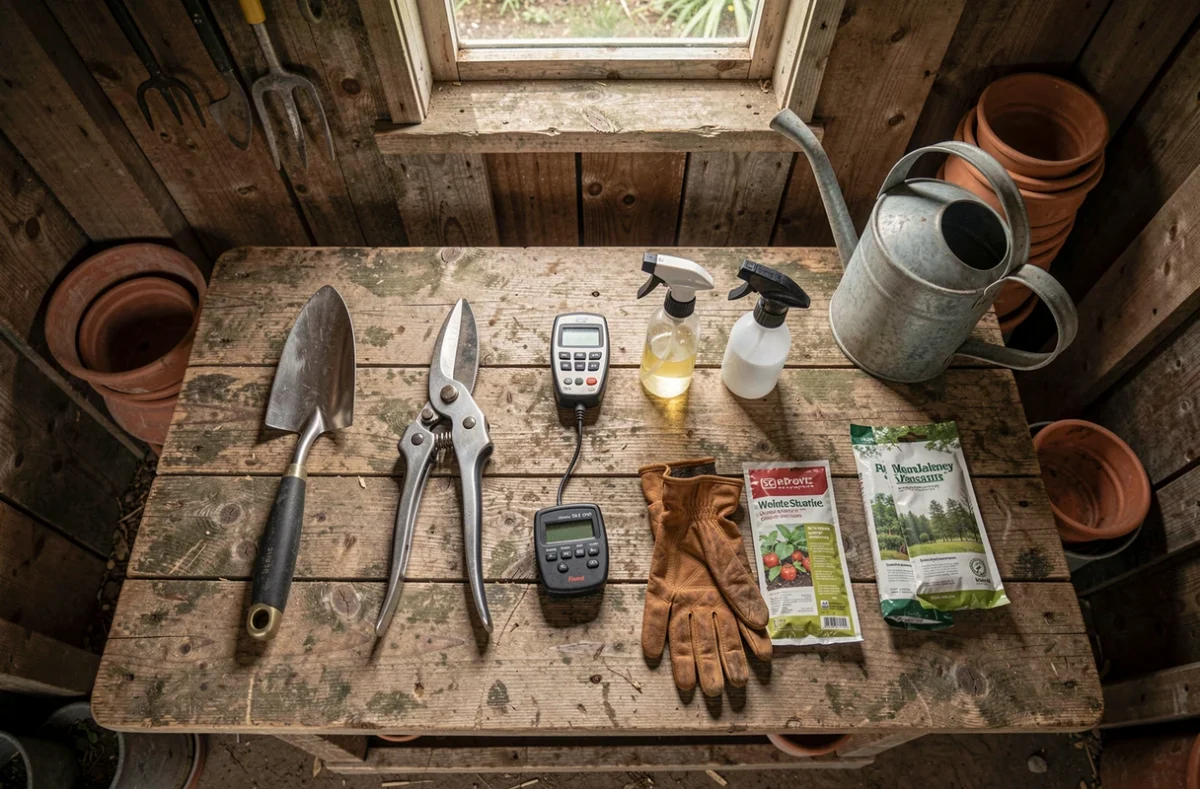
Gardening gloves are not just a cosmetic accessory. A thick leather pair protects against rose thorns and splinters, while thin latex gloves offer greater dexterity for transplanting. Having two pairs suited to different tasks helps you avoid wearing the wrong gloves by default.
Storage deserves just as much attention as the tools themselves. A garden shed or waterproof storage box extends the life of your equipment by protecting it from winter damp. In smaller spaces, a pegboard on the garage wall is enough to organize pruners, a hand cultivator, and a trowel, provided they are cleaned after each use.
A garden maintained throughout the year depends less on the number of tools you accumulate than on how well your equipment, the ground, and local requirements work together. Checking watering restrictions, considering the repairability of battery-powered tools, and choosing blades to suit the plants will help you build a durable toolkit without unnecessary purchases.