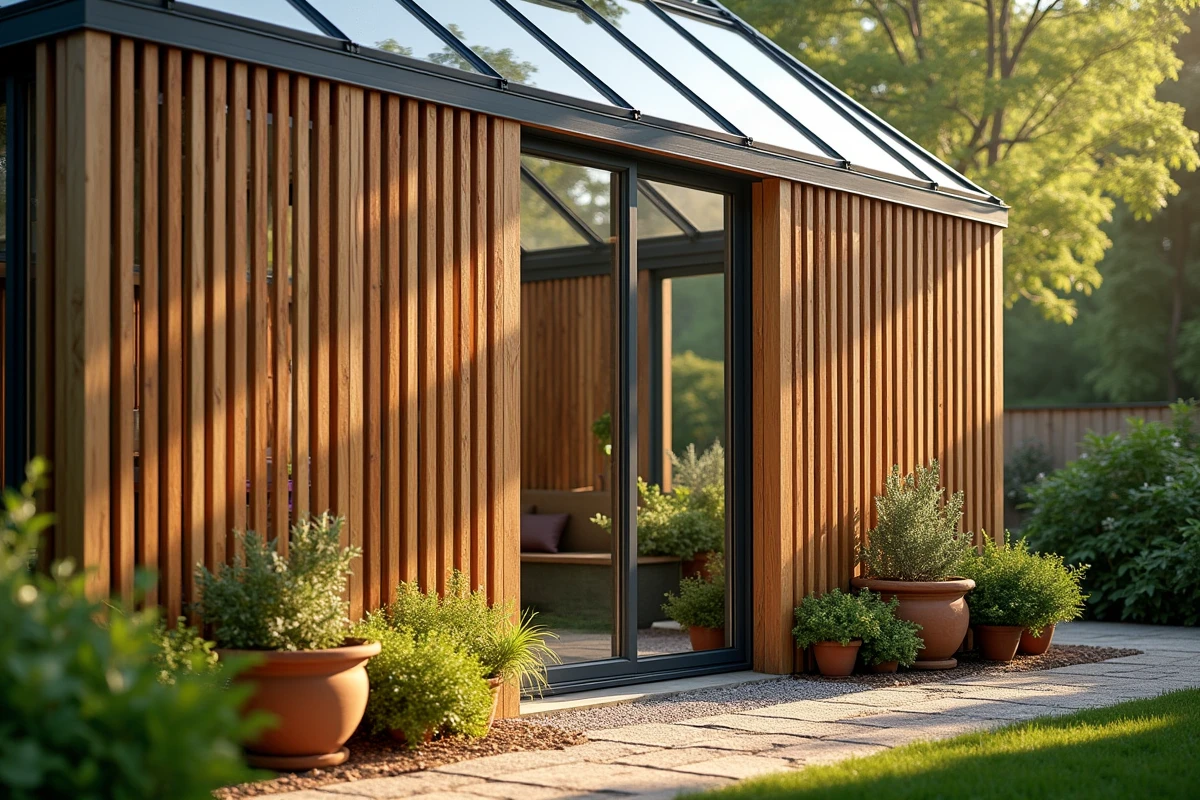
When the temperature rises under a glass greenhouse in the middle of summer, the limitations of a simple shade or synthetic cover quickly become apparent. The wooden slats address a problem that many modern solutions only partially solve: they filter solar radiation while allowing air circulation, preventing the greenhouse effect without plunging the plants into darkness.
Managing overheating in greenhouses: what the wooden slats change concretely
Under a greenhouse facing south, the temperature can rise very quickly from spring onwards. A synthetic shading cover pressed against the glazing blocks some of the light, but it also traps heat between the fabric and the glass. The wooden slats, raised above the structure, create an air gap between the slats and the glass wall.
This air gap makes all the difference. Warm air escapes through natural convection between the slats, which reduces the perceived temperature inside without resorting to mechanical ventilation. It provides diffuse shading, similar to that of a forest understory, which is particularly suitable for crops sensitive to sunburn (tomatoes, cucumbers, delicate seedlings).
For those looking for models suited to the dimensions of their structure, there are wooden slats on Agri Systems that are custom-designed, avoiding rough cuts and uncovered gaps.
In a veranda, the problem is slightly different. The aim is to protect both the occupants and the indoor plants. The slats placed on the exterior roof prevent direct radiation from reaching the glazing, which limits the temperature rise much more effectively than an interior shade that heats up once touched by the sun.
Wooden slats versus synthetic alternatives: a field comparison
We are often asked why not opt for a polyethylene shade net, which is cheaper to purchase. The answer lies in two points: durability and thermal behavior.
- A synthetic net degrades under UV light in just a few seasons. It becomes brittle, tears in the wind, and eventually allows light to pass through unevenly. The wooden slats, if the wood type is well chosen, retain their shading properties much longer, often beyond a decade with minimal maintenance.
- Wood does not accumulate heat like plastic. A black net in full sun becomes scorching and radiates that heat downwards. The thicker wooden slats remain at a moderate temperature and do not create localized hot spots.
- The weight of wooden slats is an advantage in strong winds: they stay in place without a complex fixing system, whereas a lightweight cover requires tensioners and can easily lift.
The only point where synthetic materials have the advantage is the price per square meter at purchase. Feedback varies on this point, but the total cost over several years leans in favor of wood since it does not need to be replaced every two or three summers.
Pergola with slats versus retractable shade
In a veranda, the motorized retractable shade seems more practical. You open it, you close it. In reality, its mechanism wears out, the fabric gets dirty, and its replacement is expensive. A wooden slat placed on a pergola-type structure requires less mechanical maintenance and offers constant shading without daily intervention.
The downside is that it cannot be retracted in winter when you want to capture maximum light. The field solution is to use removable slats, attached with hooks or slides, which can be taken down in autumn and stored safely.
Choosing the wood type and treatment for durable shading slats
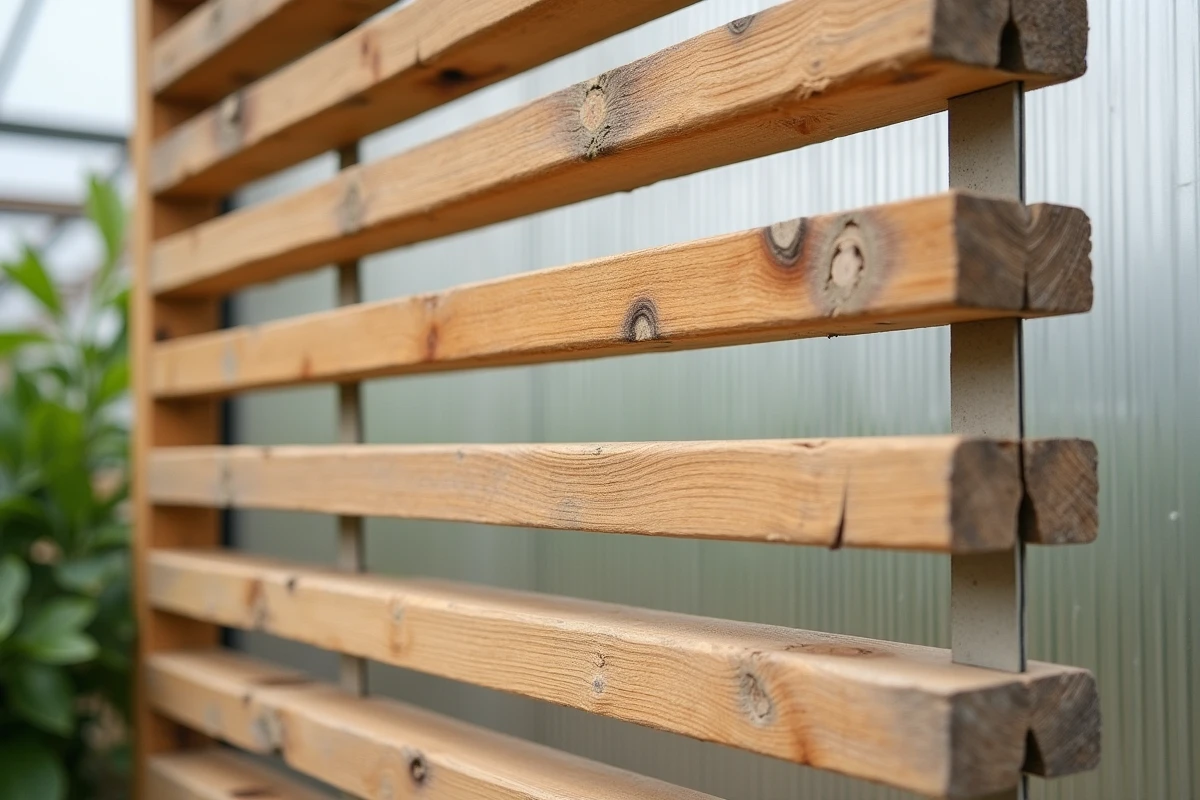
Pine remains the most common wood type for slats. Its availability-price ratio makes it the default choice in most catalogs. An autoclave treatment or a stain applied before the first installation significantly extends its resistance to weather and fungi.
Untreated wood grays in one season, but this graying does not affect its mechanical properties or shading ability. It is primarily an aesthetic issue. If the natural gray appearance is not bothersome, one can forgo treatment and let the wood age.
For very humid environments (greenhouses with frequent watering, verandas in rainy areas), a fungicidal treatment in addition to the stain is preferred. The goal is not to make the wood waterproof, but to prevent fungi from weakening the slats at the fixing points.
Minimal maintenance for lasting protection
Maintenance boils down to two actions per year:
- A dry brushing in spring to remove moss and dust accumulated during winter.
- An application of stain or linseed oil every two to three years, depending on exposure. This can be done with a wide brush in less than an hour for a standard greenhouse.
- A check of the fixings (hooks, stainless steel screws) each time the slats are reinstalled if they are removable.
No need to sand or strip between stain applications, unlike cladding or a wooden deck that undergoes mechanical stress.
Protection against hail: an often underestimated use of wooden slats
Beyond shading, wooden slats serve as a physical shield against hailstones. A glass or polycarbonate greenhouse remains vulnerable to impacts, especially during increasingly frequent hail events due to climate change.
The slats absorb the kinetic energy of hailstones before they reach the glass surface. This is not absolute protection against very large hailstones, but the slats are sufficient to stop the majority of common impacts that crack or puncture thin polycarbonate.
This dual use (shading in summer, hail protection in spring) justifies leaving the slats in place for an extended period rather than only installing them during the heat. You gain peace of mind without multiplying specialized equipment.
Wood absorbs shocks without permanently deforming, unlike a net that stretches after an impact. A slat damaged by a hailstone can be easily repaired by replacing one or two slats, without disassembling the whole structure.