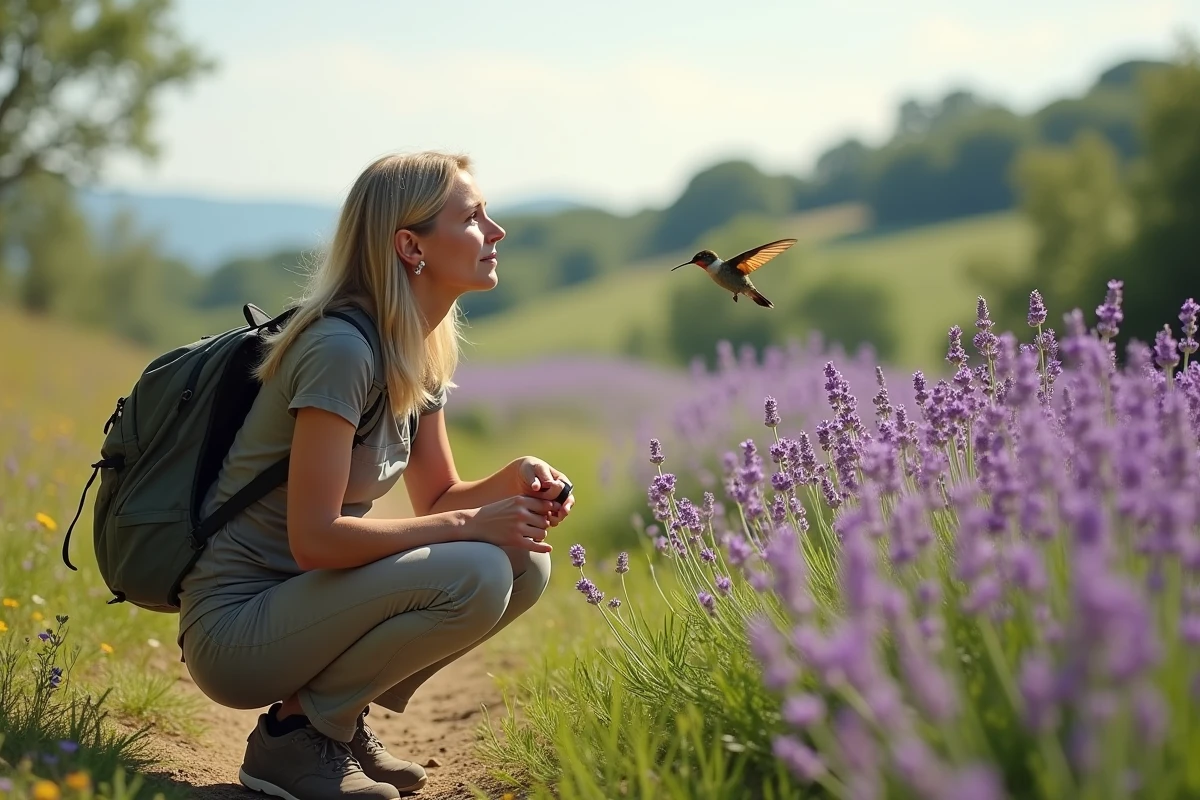
The term “hummingbird moth” can be misleading. In France, it refers to only one butterfly: the Hummingbird Hawk-moth. Its silhouette resembles that of a hummingbird, but it is indeed classified within the Sphingidae family. Hovering flight, astonishing speed, this pollinator is unlike any other.
The Hummingbird Hawk-moth continues its journey in broad daylight, staying true to the corolla when other insects have deserted. Its ability to nectar from flowers even when competition fades makes it a companion in our gardens, both urban and rural. It showcases the adaptability of certain species in the face of the decline of traditional pollinators.
Why the hummingbird moth intrigues and fascinates in France
It is impossible to remain indifferent to the hummingbird moth, also known as macroglossum stellatarum. Its speed, its gray and orange coloration, its thin wings beating up to 80 times per second: this diurnal butterfly confuses the senses. Seen from a distance, it blends in with a hummingbird, so surprising is its hovering flight in the European landscape.
In gardens, this hummingbird sphinx flits from flower to flower. Its elongated proboscis unfurls to suck nectar without brushing the petals. It is often spotted on lavender or sage, in a precise ballet where agility makes the difference. Unlike the nocturnal butterflies of the same family, it is active under the sun, revealing the unexpected diversity of its species across the territory.
France hosts common species of hummingbird moths, also found in Spain, Portugal, and as far as North Africa. Hummingbird insects in France, sometimes called sphinx moths or milkweed sphinxes, demonstrate a rare colonization ability. From meadows to urban spaces, their presence tells a story of adaptation in the face of the scarcity of usual pollinators. Observing the hummingbird moth is to discover a unique place in local biodiversity.
The essential role of the hummingbird moth in pollination and biodiversity
Discreet yet decisive, the hummingbird moth marks the French ecosystems with its presence. Unlike nocturnal butterflies, this hummingbird sphinx operates in broad daylight, contributing to the pollination of many wild and cultivated flowers. Its proboscis, sometimes two centimeters long, gives it access to nectars that are unreachable for bees and bumblebees.
The hummingbird moth has its preferences: sage, lavender, and other native species. Its hovering flight, both rapid and precise, optimizes contact with the anthers of flowers. Pollen then travels further, promoting plant reproduction over distances that other insects cannot cover.
Summer flowering peaks benefit from this activity. Few butterflies match its endurance, especially where pollinators tend to disappear. Its presence remains a sign of the vitality of habitats and the abundance of nectar-rich plants in France.
Observing the hummingbird moth is to measure how these hummingbird insects shape the floral future and the dynamics of plant communities. Their daily ballet, discreet yet constant, weaves an essential fabric for life.

Observe and protect the hummingbird butterfly: simple actions to preserve an ally of our ecosystems
The hummingbird butterfly, more precisely the hummingbird moth, can be observed in gardens, parks, or sunny edges. Its compact silhouette, its flapping wings, and its hovering flight remind one of the liveliness of the hummingbird. To spot it, favor gentle mornings when it goes to nectar from nectar-rich plants: lavender, sage, buddleia.
Here are some concrete actions to welcome and protect this pollinator in your environment:
- Favor the planting of nectar-rich flowers, an asset to attract the hummingbird moth and enhance biodiversity.
- Reduce the use of pesticides as much as possible: this species is very vulnerable to chemical substances, which contribute to the disappearance of habitats and disrupt the natural balance.
- Create spaces left wild: fallow lands, hedges, or natural flowerbeds become refuges and food reserves for these pollinators.
The presence of butterflies in our landscapes depends on our daily vigilance. Under the dual threat of climate change and anthropogenic pressure, these species see their territories fragmented. Taking the time to observe, identify, and protect is to preserve much more than just an insect: it is to ensure the continuity of a discreet yet vital link in biodiversity. Each encounter with the hummingbird sphinx, each flight suspended above a flower, reminds us that the richness of life sometimes hinges on a mere flap of wings, and on our ability to defend it.